What I say most in violin lessons
The most common mistake I correct in violin lessons is pressing into the string when the sound needs more bow. I know this because I counted. I took the transcripts of 432 of my lessons, about 2 million of my own words from 2021 to 2026, and tallied what I actually say.

Daniel Kurganov, violinist and teacher
October 31, 2026 · 8 min read
I could only do this because of Arco. It keeps a transcript and Lesson Notes for every lesson I teach, and it can answer questions across all of them. Nobody can hold 432 lessons in their head, and I certainly can’t.
I expected the count to confirm what I think I teach. Some of it did. Some of it was embarrassing: I say “you know” 11,187 times, which is about 26 times a lesson, and my students have been very polite about it. But underneath the verbal tics, a clear picture came out, and it is a useful one if you play the violin or teach it.
Before you read on, test your own instinct. Pick the phrase you think I say more often.
Which do I say more often in lessons?
More bow, less pressure
You’re playing it with a lot of clarity now, and I think the pianissimo can be more hazy. More bow. Less pressure, more bow.
I say “more bow” 801 times and “less bow” 293 times. I say “less pressure” 138 times and “more pressure” 47 times. Both ratios are close to three to one, and they point the same way.
When a student wants more sound, the instinct is to push down. But the string can only take so much weight at a given bow speed and sounding point. Past that, the sound chokes, the hand tightens, and the natural response is to press harder. Add bow speed instead and the string can carry more of what you were already giving it.
Less bow, but fast bow. Right now when you do fast bow, you’re using more bow. The two don’t have to be correlated.
This does not mean more bow is always the answer. “Too much bow” comes up 103 times, usually when a student has confused a fast bow with a long one. Those are separate controls. You can use very little bow, very fast.
 When you truly run out of bow, you can invent some. This masterclass shows how.My favorite bow arm trick for more sound
What I want is a bow speed you chose on purpose. Notice how often the problem runs the other way, too: “You’re saving way too much bow” is something I have said out loud to a person holding a full-length bow.
“Too much” beats “not enough” eleven to one
At least for this exercise, I want you to do almost nothing, so that your motions can be really aligned with rhythm.
This was the number that surprised me most. I say “too much” 1,344 times. “Not enough” gets 122. “Too little” gets 11.
You might think this contradicts everything I just said about using more bow. It doesn’t. Students are stingy with one thing, the bow, and they overspend on everything else: pressure, effort, grip, motion, the number of things they are trying to control at once. When a passage gets hard, we add. The note does not speak, so we press. The shift feels uncertain, so we squeeze. Each addition is reasonable, and together they are the reason it stays hard.
Everyone rushes, and almost everyone plays too loud
The pairs, side by side
| Phrase | Times said | Compared with | Times said |
|---|---|---|---|
| More bow | 801 | Less bow | 293 |
| Less pressure | 138 | More pressure | 47 |
| Too much | 1,344 | Not enough | 122 |
| Too fast | 299 | Too slow | 72 |
| Too loud | 95 | Too soft | 16 |
| More horizontal | 151 | More vertical | 11 |
| Feel | 5,066 | Hear | 2,225 |
| Too early | 63 | Too late | 63 |
Even bow speed. Anticipate string crossings with the arm. Don’t rush. Fill each note.
“Too fast” beats “too slow” about four to one. “Don’t rush” appears 261 times on its own. “Too loud” beats “too soft” almost six to one, which will surprise anyone who has been told to project.
The one that made me laugh is the last row. “Too early” and “too late” are tied at exactly 63. Overall tempo has a direction: nearly everyone speeds up. The timing of a single event, like a shift or a string crossing, doesn’t seem to have one. People miss on both sides. The better remedy for rushing is usually sound. When each note has to be filled, it gets harder to hurry past it.
The bow moves sideways
I say “more horizontal” 151 times and “more vertical” 11 times. The word “horizontal” alone comes up 522 times. The string vibrates because the hair pulls it sideways, yet the instinct under pressure is to work up and down: pressing, lifting, pecking, jabbing at bow changes. If I could tape one word to every music stand, it might be this one. It is the same idea behind most of how I rebuild a spiccato.
I say “feel” twice as often as “hear”
Try to be very sensitive to the feeling of friction, which is like a composite of the speed, pressure, sounding point. They all form this one feeling.
I say “feel” 5,066 times. “Hear” and “listen” together come to 2,713. That made me uneasy at first, because I would tell you that everything starts with the ear. I think the explanation is simple. In a lesson, I am doing the listening for both of us. What I can’t do is feel it for you. So my job is to translate what I hear into a sensation you can find again at home.
That last idea matters. Nobody can monitor speed, pressure and sounding point as three separate dials while playing Brahms. They have to collapse into a single feeling you can recognize. Also, for whatever it’s worth, I say “sound” 5,702 times and “tone” 112 times. I have no theory about this one.
The most common “don’t” is permission
You don’t have to go all the way to the frog.
I expected my most common “don’t” to be a prohibition. It isn’t. “Don’t have to” and “don’t need to” together appear 872 times. “Don’t do that,” “don’t do this” and “don’t do it” together appear 189 times. “Don’t be afraid” gets 125.
This is my favorite thing in the whole data set. A lot of what looks like correcting is actually removing an obligation the student invented. You don’t have to sustain that note. You don’t have to press as much. You don’t have to shift there. The student thought there was a rule, and the rule was the problem.
Left-hand problem, bow answer
It’s your bow, not the left hand. Half of the time it’s just your bow.
Across all 432 lessons, I say “bow” 11,829 times and “finger” or “fingers” 5,343 times. To see whether that gap means anything, I also went through 191 lessons from 2021 to 2023 in more detail, tagging what the student brought up and what the lesson ended up being about. In 140 of them, the student raised a left-hand problem: intonation, shifting, vibrato, articulation. In 78 of those 140, the main work of the lesson ended up on the bow.
That doesn’t mean the left hand is unimportant, and the students were not wrong that something was off. Shifting comes up in 75% of these lessons, and intonation in 55%. But a note can sound out of tune because the sound under it is unstable, and fast fingers can sound messy because the bow is reacting late. The left hand is where you notice the problem. It isn’t always where the problem lives.
What I barely say
The word “metronome” appears 172 times, in 75 of the 432 lessons. That is 17% of them. I am not against metronomes. But sound and physical feeling come first, and rhythm and tempo come after. Meanwhile, I say “because” 7,367 times, about 17 times a lesson, and I’m happy with that one.
Three things to try
I asked Arco to go through my lessons for the experiments I actually give students, and through expert knowledge for what other teachers recommend. I’d start with these three.
A really good practice is to suddenly use less pressure on the actual finger. It might feel weird, but you set a limit, like maximum pressure.
- Compare more bow with more pressure. Play a short passage with your usual pressure. Then play it again with less pressure and more bow, keeping the stroke horizontal. If the second version speaks more evenly, pressure was doing work that bow travel could do more freely.
- Set a maximum pressure. Decide how hard the finger or the bow is allowed to press, then refuse to exceed it, and solve the passage some other way. It will feel wrong at first, especially in expressive music.
- Find the sounding point on one long note. This one is Ivan Galamian’s. Start with a slow bow and fairly heavy pressure, and look near the bridge for the most resonant sound. Keep the same pressure, gradually speed up the bow, and follow the sounding point toward the fingerboard. The sound should stay just as resonant.
And before you repeat a hard spot, name one thing you don’t have to do.
What this count can’t tell you
This is one teacher. Most of these students are adults and advanced players, so lessons with children would look different. A word count shows what I say, not whether it worked. It also can’t tell you when I’m wrong, which I’m told happens.
Questions people ask
- What is the most common mistake violinists make?
- In my lessons, the most common one is trying to get more sound by pressing when the bow needs more speed. I say “more bow” about three times as often as “less bow,” and “less pressure” about three times as often as “more pressure.”
- How do I get a bigger sound on the violin without pressing?
- Try the same passage with less pressure and more bow, keeping the stroke horizontal, and find the sounding point where the string responds. If the sound gets harsh, change the speed or sounding point before you add force.
- Why does my violin sound scratchy?
- Usually the pressure is too high for the bow speed and sounding point you’re using, or the hand is tight enough that it can’t respond to the string. Try the same note with less weight and a faster bow, then move the sounding point a little until the sound clears.
- Should I practice with a metronome?
- Yes, at the right stage. In my lessons it comes after the sound and the physical feeling are organized. I tell students the metronome is a partner and not a tyrant.
Sources
- Notes from Daniel Kurganov’s Lessons in Arco.
- Ivan Galamian, Principles of Violin Playing and Teaching (1962), on bow speed, pressure and sounding point.
- Daniel Kurganov, “My favorite bow arm trick for more sound”, YouTube.
How this was made
I counted exact phrases in my side of each lesson transcript with a plain script. The sample is 432 lessons, 658 hours and 2,072,683 words.
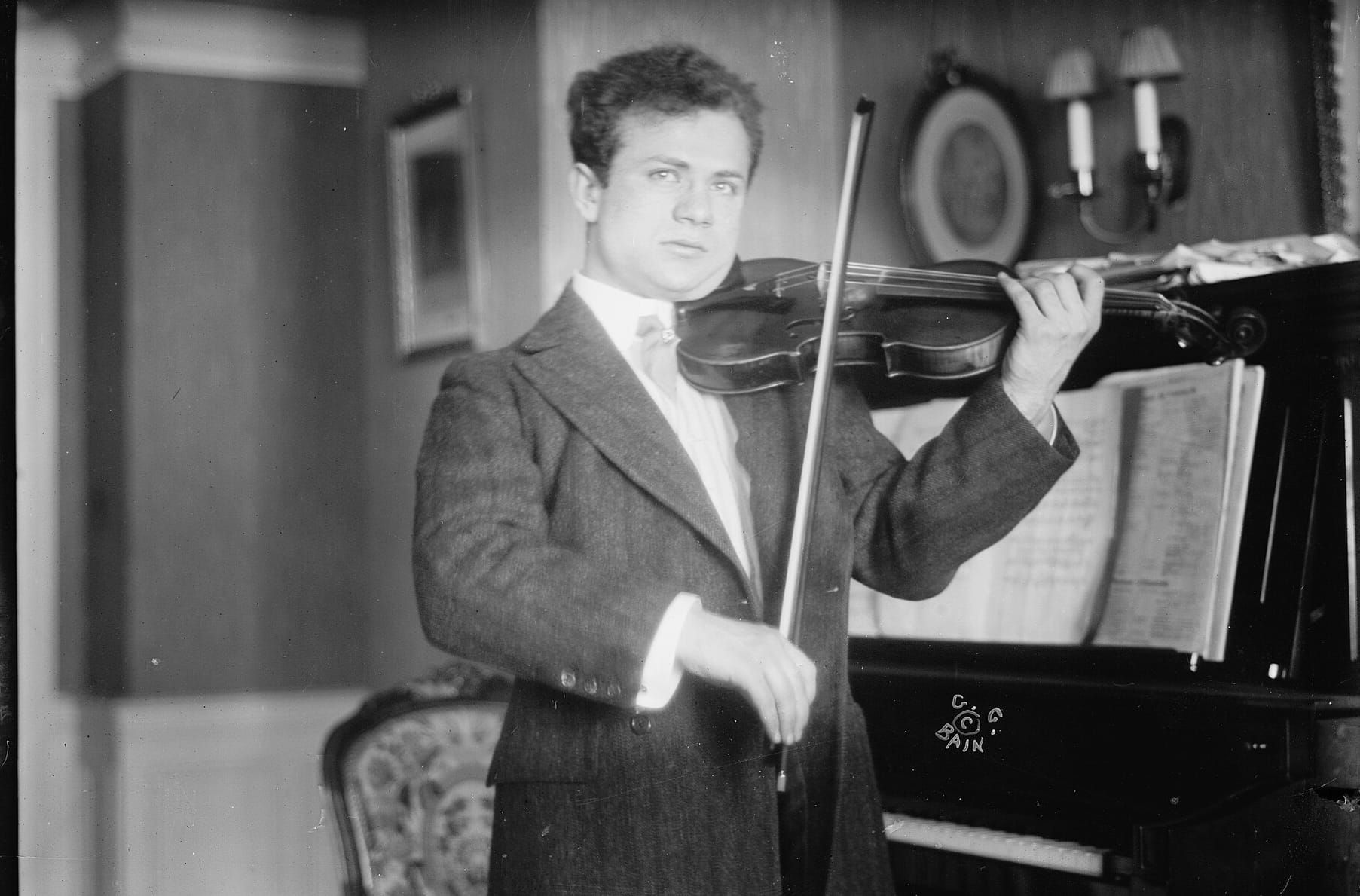
Pictures: Mischa Elman, public domain, via Wikimedia Commons.
Keep reading

This article is only possible because Arco keeps every lesson I teach. Record your own lessons with it, and find out what you keep saying, or what you keep hearing.
Start Free